
 Français
  Deutsch
  Español
  Italiano
  Nederlands
  Português
  Brasileiro
  Ελληνικά
  Polski
  Română
  Svenska
  Türkçe
  Български
  हिंदी
हिंदी 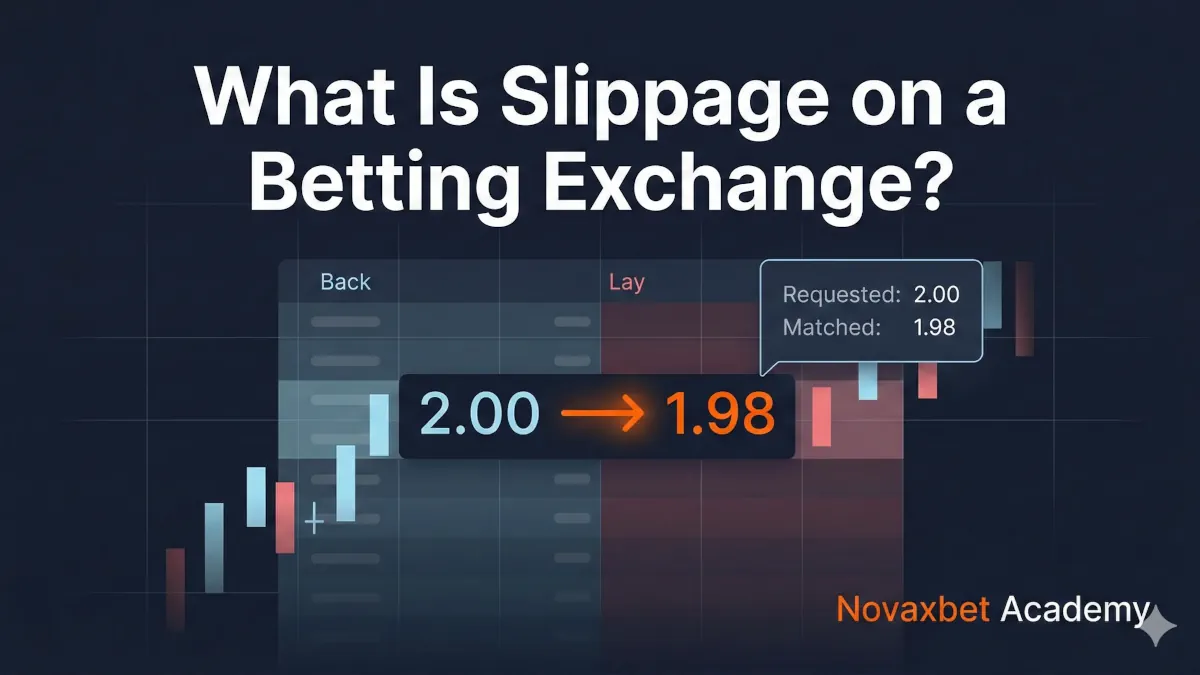
What Is Slippage on a Betting Exchange?
Understanding price slippage and how order execution differs from expected odds.
Novaxbet Editorial •2026-03-02•5 min read
When placing a bet on a betting exchange, many participants assume their order will be executed exactly at the price displayed on screen. In reality, execution depends on available liquidity at that precise moment.
Slippage occurs when the final matched odds differ from the expected odds at the time the order was placed.
This difference is not an error or malfunction. It is a natural consequence of how exchange markets operate.
Unlike traditional bookmakers, exchanges match orders between participants rather than guaranteeing prices.
Execution therefore depends on market depth, order timing, and competing activity.
How Slippage Happens
Next reading
Every betting exchange operates through an order book containing available back and lay offers at multiple price levels.
When an order enters the market, it consumes available liquidity starting from the best available price.
If sufficient liquidity does not exist at that price, the remaining portion of the order continues matching at worse prices.
This process creates slippage.
Example
Suppose the market shows:
- Back price: 2.00
- Available liquidity: €500
A participant submits a back order for €1,000.
Execution occurs as follows:
- €500 matched at 2.00
- Remaining €500 matched at 1.98
Final average matched price becomes lower than expected.
The trader experiences negative slippage.
Positive vs Negative Slippage
Slippage does not always work against the participant.
Negative Slippage
Occurs when execution happens at worse odds than requested.
Example:
- Intended back at 2.00
- Actual average execution at 1.98
Higher cost of entry.
Positive Slippage
Occurs when execution happens at better odds.
Example:
- Intended lay at 2.00
- Execution matched partially at 2.02
Improved pricing outcome.
Exchange markets allow both outcomes because prices continuously move during matching.
Market Orders vs Price-Controlled Orders
The probability of slippage depends heavily on order type.
Aggressive (Market-Taking) Orders
Orders that immediately accept available prices.
Characteristics:
- Instant execution
- Higher slippage risk
- Liquidity consumption
Used when speed matters more than price precision.
Passive (Limit) Orders
Orders placed at a specific price waiting to be matched.
Characteristics:
- Controlled pricing
- Lower slippage risk
- Uncertain execution timing
Used when price discipline is prioritized.
Execution certainty and price certainty rarely coexist.
Liquidity Depth and Execution Quality
Liquidity depth describes how much money exists across nearby price levels.
Deep Market Example
Major football match close to kickoff:
| Price | Available |
|---|---|
| 2.00 | €50,000 |
| 1.99 | €45,000 |
| 1.98 | €40,000 |
Large orders execute with minimal price change.
Slippage remains small.
Thin Market Example
Lower league event days before start:
| Price | Available |
|---|---|
| 2.00 | €200 |
| 1.98 | €150 |
| 1.94 | €120 |
Even moderate orders remove several levels instantly.
Slippage increases dramatically.
Liquidity determines execution stability.
Timing Risk and Market Competition
Exchange markets are competitive environments where multiple participants submit orders simultaneously.
Between the moment a trader clicks and the order reaches the market:
- other traders may consume liquidity,
- automated strategies may react faster,
- prices may already move.
Slippage often reflects competition speed rather than incorrect pricing.
Latency matters.
Volatility and Slippage
Slippage becomes more frequent during periods of rapid price movement.
Common high-volatility moments include:
- team news announcements,
- injury confirmations,
- red cards,
- late match situations,
- event start transitions.
During volatility, liquidity constantly relocates.
Displayed prices may disappear before execution completes.
Partial Matching and Average Price
Exchange orders are frequently matched in multiple fragments.
Instead of a single execution price, traders receive an average matched price calculated across all fills.
Example:
- €300 matched at 2.00
- €400 matched at 1.99
- €300 matched at 1.97
Average matched odds ≈ 1.986
Understanding average execution is essential when evaluating performance.
Hidden Cost of Slippage
Slippage represents an indirect trading cost.
Even with low commission rates, repeated slippage reduces long-term profitability.
Two traders paying identical commission may achieve different results solely due to execution quality.
Execution efficiency becomes a competitive advantage.
Managing Slippage Risk
While slippage cannot be eliminated entirely, it can be managed.
Common approaches include:
- trading in high-liquidity markets,
- splitting large orders,
- using limit prices,
- avoiding volatile moments,
- monitoring market depth before execution.
Professional participants manage execution risk as carefully as directional risk.
Slippage as a Structural Feature
Slippage is not a flaw of betting exchanges.
It is evidence of a live market where prices adjust dynamically according to supply, demand, and competition.
Perfect execution would imply a static market — which exchanges are not.
Understanding slippage transforms execution from uncertainty into measurable market behavior.
In exchange environments, price is only part of the trade.
Execution quality completes it.