
 Français
  Deutsch
  Español
  Italiano
  Nederlands
  Português
  Brasileiro
  Ελληνικά
  Polski
  Română
  Svenska
  Türkçe
  Български
  हिंदी
हिंदी 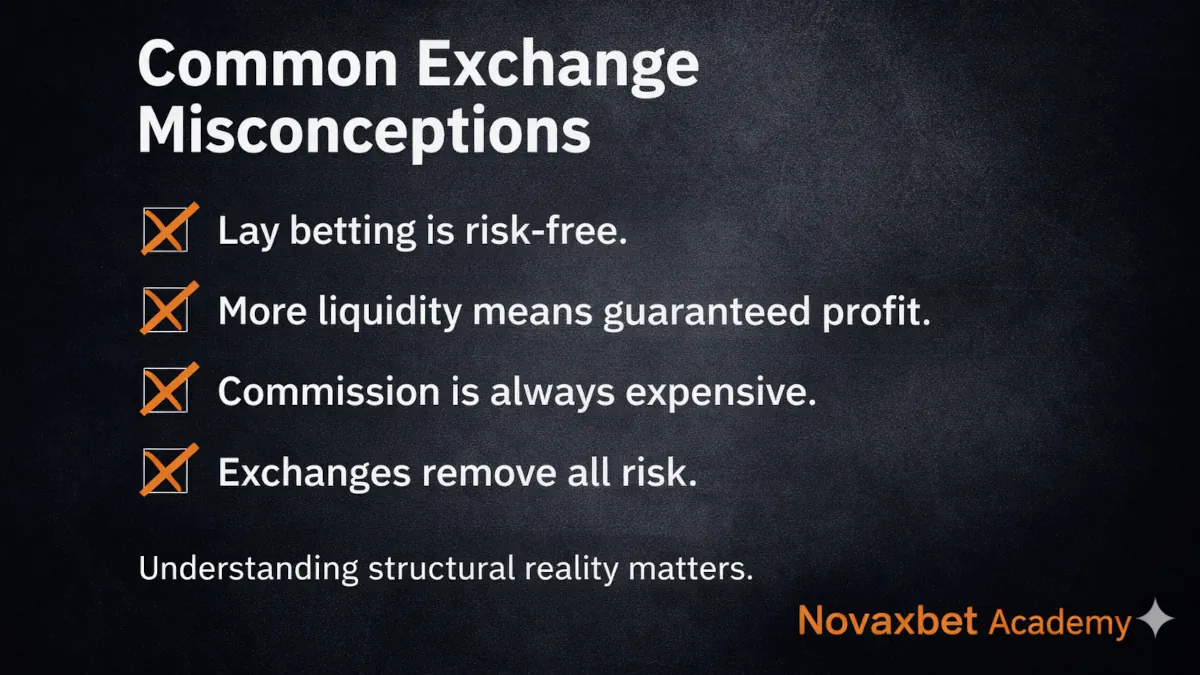
Common Misconceptions About Betting Exchanges
Clarifies frequent misunderstandings about exchange mechanics and risk.
Novaxbet Editorial •2026-03-15•6 min read
Betting exchanges are often presented as more advanced alternatives to traditional sportsbooks. Because of their marketplace structure, many participants assume they fully understand how exchanges operate after learning only a few basic concepts.
In reality, exchange markets contain several structural mechanics that are frequently misunderstood. Many assumptions about liquidity, risk, pricing, and execution are based on simplified explanations that do not fully reflect how these markets behave.
Clarifying these misconceptions helps participants interpret exchange markets more accurately and avoid incorrect expectations about how betting exchanges function.
Misconception 1: Betting Exchanges Always Offer Better Odds
Next reading
One of the most common claims is that betting exchanges always provide better odds than bookmakers.
While exchange markets often produce more competitive pricing, this is not guaranteed in every situation.
Exchange odds depend entirely on participant activity and liquidity. If there are few traders in a market, spreads may widen and available prices may temporarily become worse than those offered by bookmakers.
For example, in a low-liquidity tennis match hours before the event begins:
| Market | Best Back |
|---|---|
| Exchange | 1.83 |
| Bookmaker | 1.86 |
In this scenario, the bookmaker offers a better price.
As liquidity increases closer to event start, exchange pricing may become more efficient and competitive again.
Better odds are therefore a common outcome, but not a structural guarantee.
Misconception 2: Lay Betting Is Inherently More Dangerous
Another frequent misunderstanding is that laying a bet is fundamentally riskier than backing.
Lay bets can involve larger potential liabilities relative to stake, which often creates the perception of greater danger.
However, risk in betting exchanges depends on exposure management, not on whether a position is back or lay.
Consider two examples:
Back Bet
- Stake: €100
- Odds: 2.00
- Maximum loss: €100
Lay Bet
- Lay stake: €100
- Odds: 2.00
- Liability: €100
In both cases the maximum loss is identical.
Lay betting simply expresses the opposite opinion in the market. When used properly within controlled exposure limits, its risk characteristics are comparable to backing.
The perception of greater danger often arises from misunderstanding liability calculations rather than from the structure of lay betting itself.
Misconception 3: Exchanges Predict Outcomes Better Than Bookmakers
Exchange prices are sometimes interpreted as “the most accurate prediction” of an event's outcome.
While exchange markets often incorporate information quickly due to participant competition, prices do not represent objective predictions.
They represent the current balance of capital between opposing views.
Odds reflect:
- available liquidity
- trading activity
- participant opinions
- information flow
- risk tolerance
If a large amount of capital backs a particular outcome, odds shorten even if the underlying probability has not objectively changed.
Exchange prices therefore represent market consensus, not absolute truth.
Markets move toward efficiency over time, but they never perfectly predict results.
Misconception 4: Commission Makes Exchanges More Expensive
Because exchange platforms charge commission on winnings, some participants assume that exchanges are more expensive than bookmakers.
In reality, cost comparisons must consider both commission and embedded margin.
Bookmakers include their profit inside the odds themselves. This margin is paid regardless of whether the bettor wins or loses.
Exchange commission only applies to net winnings.
Example comparison:
| Platform | Pricing Model |
|---|---|
| Bookmaker | Margin embedded in odds |
| Exchange | Commission on net profit |
Even after commission, exchange prices often remain closer to true probability than bookmaker odds.
The visible nature of commission can create the impression of higher cost, even when the overall pricing structure is more efficient.
Misconception 5: Liquidity Means Unlimited Money
Many newcomers interpret liquidity figures in exchange markets as proof that any bet can be matched instantly at the displayed price.
Liquidity numbers only represent available capital at specific price levels.
For example:
| Price | Available |
|---|---|
| 2.00 | €500 |
| 1.99 | €700 |
| 1.98 | €900 |
If a participant submits a €2,000 back order at 2.00:
- €500 is matched at 2.00
- €700 is matched at 1.99
- €800 continues matching at 1.98
The final average execution price becomes worse than expected.
Liquidity must therefore be interpreted as depth across multiple price levels, not as unlimited volume at a single price.
Misconception 6: Exchanges Remove the House Edge Completely
Because exchanges allow participants to trade against each other, some assume the “house edge” disappears entirely.
In practice, several structural costs remain:
- commission on winnings
- bid-ask spread
- slippage during execution
- price inefficiencies in thin markets
While exchanges typically reduce embedded margins compared with bookmakers, participation still involves transactional costs.
These costs arise from market mechanics, not from a centralized operator taking a directional position.
Misconception 7: Faster Information Always Wins
It is often believed that the fastest traders always dominate exchange markets.
Speed can be important in highly reactive situations such as:
- injury announcements
- red cards
- starting lineup confirmations
- in-play momentum changes
However, speed alone does not determine success.
Exchange markets reward a combination of factors:
- risk management
- capital allocation
- price interpretation
- liquidity awareness
- disciplined execution
Information speed may create short-term advantages, but sustained performance depends on broader market understanding.
Misconception 8: Price Movement Always Reflects New Information
Not every price change in an exchange market indicates new information about an event.
Prices may move for purely structural reasons, including:
- large orders entering the market
- liquidity providers cancelling orders
- temporary imbalances in order flow
- automated trading activity
For example, if a large lay order removes several price levels, odds may drift sharply even though nothing has changed about the underlying event.
Understanding the difference between informational movement and structural movement is essential when interpreting market behaviour.
Why Misconceptions Persist
Many misunderstandings about betting exchanges persist because simplified explanations focus on only one aspect of the system.
Participants may learn about:
- back vs lay betting
- commission rates
- price advantages
but overlook deeper structural mechanics such as liquidity distribution, order book dynamics, and execution behavior.
Exchange markets are not simply sportsbooks with better odds. They operate as financial marketplaces where prices continuously emerge from interaction between participants.
Understanding the mechanics behind these interactions reduces confusion and leads to more realistic expectations about how exchange markets behave.
Interpreting Exchange Markets More Accurately
Betting exchanges provide a flexible and transparent environment for price discovery. However, interpreting these markets requires more than basic familiarity with odds.
Participants who understand:
- liquidity structure
- order book dynamics
- execution mechanics
- cost composition
- risk exposure
can evaluate prices and market behaviour more effectively.
Rather than relying on simplified assumptions, viewing exchanges as dynamic marketplaces helps explain why prices move, how risk is transferred, and how costs emerge.
Ultimately, exchange markets function not as prediction engines but as systems where probability, capital, and competition interact continuously.