
 Français
  Deutsch
  Español
  Italiano
  Nederlands
  Português
  Brasileiro
  Ελληνικά
  Polski
  Română
  Svenska
  Türkçe
  Български
  हिंदी
हिंदी 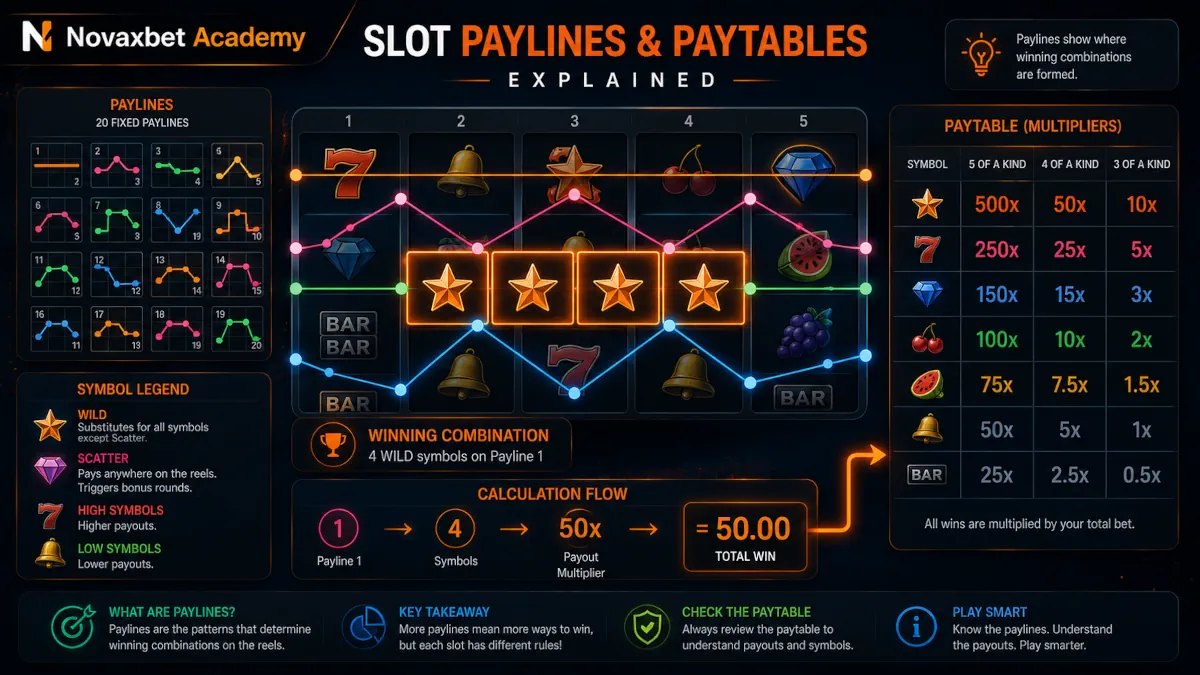
Slot Paylines and Paytables Explained
Guide to paylines, symbols, and paytables used to calculate slot wins.
Novaxbet Editorial •2026-06-19•8 min read
Slot paylines and paytables are the core rulebook of any slot game. If you understand these two elements, you can read how wins are formed, what symbols are worth, and how the game calculates payouts.
Many beginners focus only on visuals or bonus features. But the paytable and payline model are what actually define how money moves in the game.
This guide explains how paylines and paytables work, the most common symbol types, and how to interpret payout information before you spin.
What Is a Payline?
Next reading
A payline is a valid pattern across the reels where symbols must align to create a winning combination.
In classic slots, paylines were usually simple horizontal lines. In modern video slots, paylines can be:
- horizontal,
- diagonal,
- zig-zag,
- V-shape,
- or other fixed paths.
If matching symbols appear on an active payline according to game rules, the game awards a payout based on the paytable.
Left-to-Right vs Both Ways
Most slots evaluate wins from left to right. Some games also pay right to left.
This matters because the same symbol layout can pay in one game and not in another, depending on direction rules.
Always check the game info panel for:
- win direction,
- minimum matching count,
- and whether all paylines are permanently active.
What Is a Paytable?
The paytable is the payout reference chart. It tells you:
- which symbols are highest or lowest value,
- how many matching symbols are needed,
- payout multipliers for each symbol count,
- bonus trigger conditions,
- wild/scatter behavior,
- feature details (free spins, multipliers, bonus rounds).
Think of it as the contract between you and the game. Before playing, the paytable is the fastest way to understand what outcomes are possible.
How a Slot Win Is Calculated (Simple Flow)
A slot result is usually resolved in this order:
- RNG produces a reel stop outcome.
- The symbol layout appears on the grid.
- The game checks active paylines (or all ways/cluster rules in alternative formats).
- Matching combinations are identified.
- Each valid win is mapped to paytable values.
- Multipliers/modifiers are applied if the rules allow.
- Total payout is credited.
This process is automatic and very fast, but all steps are defined by the payline/paytable framework.
Common Symbol Types in Paytables
1) Regular Symbols
These are standard symbols that pay when enough identical symbols appear on a valid line/way.
General pattern:
- lower-tier symbols: more frequent, lower payouts,
- premium symbols: less frequent, higher payouts.
2) Wild Symbols
A wild typically substitutes for other regular symbols to help complete winning combinations.
Wilds often have special variants:
- expanding wild,
- sticky wild,
- walking wild,
- multiplier wild.
Important: wilds usually do not replace scatters or bonus symbols unless explicitly stated.
3) Scatter Symbols
A scatter usually pays or triggers features based on total count anywhere on reels, not on a specific payline.
Common use cases:
- direct scatter payout,
- free spins trigger,
- bonus game entry.
4) Bonus Symbols
Some slots use dedicated bonus symbols for feature activation.
Example rule:
- “3 bonus symbols trigger bonus round.”
Bonus triggers may overlap with scatters in some games, but not always.
5) Multiplier Symbols
A multiplier increases a win amount by a defined factor (e.g., 2x, 3x, 10x).
Paytable notes should specify:
- where multipliers apply (base game, bonus, or both),
- whether multipliers stack,
- any maximum cap.
Fixed Paylines vs Adjustable Paylines
Older and some modern slots allow players to choose how many paylines to activate. Many modern games use fixed “all lines active” design.
Adjustable Paylines
Pros:
- more control over cost per spin.
Trade-off:
- fewer active lines means fewer possible winning paths.
Fixed All-Payline Model
Pros:
- simple user experience,
- no accidental under-coverage of lines.
Trade-off:
- spin cost is tied to full line activation.
When comparing games, always separate:
- bet size mechanics (how stake is built), and
- payout mechanics (what wins are possible).
Paylines vs “Ways to Win”
Not all slot games use traditional paylines.
Some use ways-to-win systems (often called 243 ways, 1024 ways, etc.). In these games, you usually need matching symbols on adjacent reels from left to right, without a fixed line path.
Key difference:
- Paylines = specific mapped paths.
- Ways = adjacency-based combinations across reels.
Both systems still rely on the paytable for symbol values and feature logic.
Paylines vs Cluster Pays
Another model is cluster pays, where adjacent matching symbols form groups.
In cluster games:
- wins are based on connected symbol clusters,
- paylines are often absent,
- cascades/tumbles may create chain reactions.
This can feel very different from line-based slots, even when RTP is similar.
Reading a Paytable Correctly
A practical checklist before starting any slot:
- Check RTP and volatility in game info.
- Identify top-paying symbols and their required counts.
- Verify wild rules (substitution limits, extra effects).
- Verify scatter rules (paying vs trigger-only).
- Read bonus trigger conditions and retrigger options.
- Review multiplier behavior and caps.
- Confirm max win statement if published.
- Check minimum/maximum stake limits.
This 60-second review prevents many misunderstandings during play.
Example: Basic Payline + Paytable Calculation
Assume a 5-reel slot with left-to-right paylines.
Hypothetical paytable entry for premium symbol A:
- 3 of A = 5x line bet
- 4 of A = 20x line bet
- 5 of A = 100x line bet
If your line bet is €0.20 and you land 4 matching A symbols on an active line:
- payout = 20 × €0.20 = €4.00
If a 2x multiplier also applies to that line win:
- adjusted payout = €4.00 × 2 = €8.00
Exact behavior depends on game rules (some apply multipliers per win, some to total spin win).
Why Two Players Can Have Different Results in the Same Slot
Players often ask why outcomes differ so much even in identical games.
Main reasons:
- RNG produces independent outcomes each spin,
- high-variance symbols/features may be infrequent,
- session length differs,
- stake size changes absolute money swings,
- feature entry timing is random within game probabilities.
Paylines and paytables define what can happen, not when it must happen.
Common Misconceptions
“More paylines guarantee profit.”
No. More paylines generally increase coverage of possible combinations, but they also usually increase total stake per spin. Expected loss rate still depends on RTP and volume of play.
“A high-value symbol should appear soon because it hasn’t shown up.”
No. In regulated RNG games, spins are independent. Previous outcomes do not force a premium symbol to appear.
“If I read the paytable, I can predict the next outcome.”
No. The paytable explains payout logic, not future sequence. It helps you understand structure, not forecast exact spin timing.
“Scatter always substitutes like wild.”
Not usually. Scatter and wild have distinct roles unless explicitly combined in that game’s rules.
Strategic Use of Paytable Knowledge (Without Myths)
Paytable literacy helps in practical ways:
- choosing game types aligned with your risk tolerance,
- understanding whether value is base-game heavy or bonus-heavy,
- setting realistic expectations about hit patterns,
- avoiding confusion around “near misses” and visual noise,
- controlling bankroll through better game selection.
What it does not do:
- create a guaranteed winning strategy,
- eliminate variance,
- overcome house edge in the long run.
Relationship With RTP, House Edge, and Volatility
Paylines and paytables do not exist in isolation. They connect to broader game math:
- RTP: long-run expected return percentage.
- House edge: complement of RTP.
- Volatility: distribution pattern of wins over time.
The paytable helps you see where theoretical value is allocated:
- frequent small line wins,
- rare premium combinations,
- bonus-phase concentration,
- multiplier-driven payout spikes.
So when you compare two slots, use all layers together:
- RTP,
- volatility profile,
- payline/paytable structure,
- feature design.
Responsible Play Reminder
Casino games are designed for entertainment with mathematically defined risk. Understanding paylines and paytables improves transparency, but it does not remove uncertainty.
Practical safeguards:
- set a fixed budget before playing,
- define session time limits,
- avoid increasing stake to chase losses,
- stop when limits are reached.
Better decisions come from clear rules + disciplined limits.
Final Takeaway
If you want to understand slot games beyond surface visuals, start with two screens:
- the payline layout (how wins are recognized), and
- the paytable (how wins are valued).
Together, they explain most of what matters in slot outcomes:
- winning conditions,
- symbol importance,
- feature triggers,
- payout logic.
For beginners, this is the foundation. For experienced players, it is still the best first check before trying any new slot.