
 Français
  Deutsch
  Español
  Italiano
  Nederlands
  Português
  Brasileiro
  Ελληνικά
  Polski
  Română
  Svenska
  Türkçe
  Български
  हिंदी
हिंदी 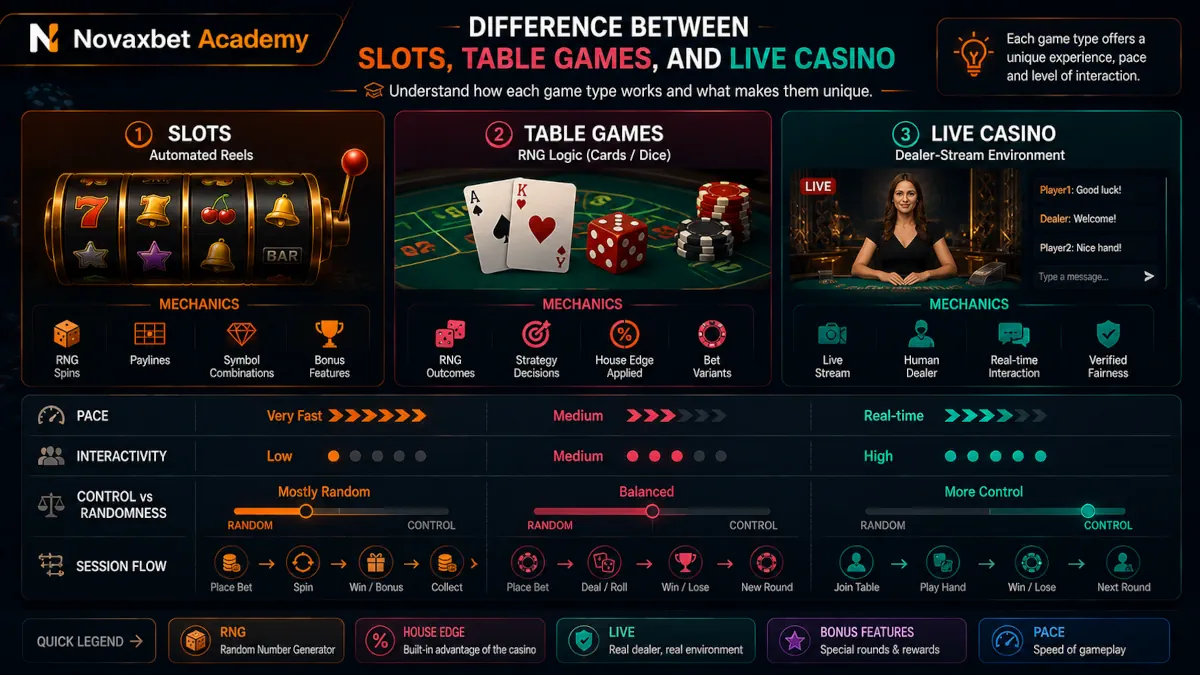
Difference Between Slots, Table Games, and Live Casino
Structural comparison of core casino game categories and how each game type operates.
Novaxbet Editorial •2026-06-19•7 min read
Many casino beginners see one lobby and assume all games work the same way. In practice, slots, RNG table games, and live casino use different mechanics, pacing, and decision models. Understanding those differences helps you choose games that match your style, budget rhythm, and attention span.
This guide compares the three main categories in a practical way: how outcomes are produced, how sessions feel, what skills matter, and where common misunderstandings happen.
The Three Categories at a Glance
Next reading
At a high level, online casino products are usually grouped like this:
- Slots: Reel-based games with symbol combinations, bonus features, and automated spin cycles.
- RNG table games: Digital versions of table classics (roulette, blackjack variants, baccarat) resolved by software logic.
- Live casino: Real dealers on video streams running physical equipment, with bets placed through a digital interface.
Even when two games share a familiar name, their experience can differ depending on category. For example, RNG roulette and live roulette both use roulette rules, but the speed, interaction, and perception of control are not identical.
How Outcomes Are Generated
Slots
Slots typically use an RNG-driven reel outcome model. A random result is produced, mapped to virtual reel positions, and then interpreted through payline, ways, or cluster rules.
Key traits:
- outcomes are independent spin to spin,
- bonus triggers are rule-based,
- payout distribution is often uneven (many small outcomes, fewer large ones).
RNG Table Games
RNG table games also rely on random generation, but the game logic follows table-game rule trees. Examples:
- RNG roulette maps to number/colour/section resolution,
- RNG blackjack applies draw rules and hand evaluation,
- RNG baccarat resolves player vs banker vs tie outcomes.
Compared with slots, RNG table games often feel more rule-transparent because players can map outcomes directly to known game structures.
Live Casino
Live casino outcomes come from physical actions in a studio (dealer shuffles, wheel spins, card reveals), transmitted by stream and synchronized with betting software.
The result path is usually:
- Betting window opens.
- Players place bets digitally.
- Dealer action occurs on camera.
- Outcome is captured and validated by the platform.
- Bets settle automatically.
Here, randomness is linked to physical game execution rather than pure on-screen simulation.
Pacing and Session Rhythm
Game category strongly affects session speed.
| Category | Typical Pace | Who Controls Tempo Most | Session Feel |
|---|---|---|---|
| Slots | Fast to very fast | Mostly player (spin timing) | Continuous, feature-driven |
| RNG table games | Fast to medium | Player + interface flow | Structured rounds, rule-focused |
| Live casino | Medium to slow | Dealer/game schedule | Social, event-based rounds |
Practical implications:
- In slots, high round volume can increase bankroll variance visibility over short time windows.
- In RNG table games, round cadence is steady but usually quicker than live formats.
- In live casino, waiting phases (bet window, dealing, confirmations) create natural pauses.
Players who prefer constant action often choose slots. Players who prefer more observation time may prefer live formats.
Decision-Making Depth: How Much Player Choice Matters
Not all categories demand the same decision complexity.
Slots: Low-to-Moderate Tactical Input
Most slots require decisions around:
- stake size,
- game selection,
- volatility preference,
- bonus buy or feature options (where available).
Once a spin starts, resolution is mostly automated. The main skill is pre-game selection and bankroll pacing, not per-round strategic branching.
RNG Table Games: Rule-Based Decision Points
Decision depth varies by game:
- Roulette: bet type selection and coverage strategy.
- Blackjack variants: hit/stand/double/split decisions under game-specific rules.
- Baccarat: fewer decision branches, mostly side-bet management and stake discipline.
Some RNG table games allow players to apply consistent frameworks, but short-term outcomes remain uncertain.
Live Casino: Decision + Timing + Table Context
Live games combine rule decisions with table dynamics:
- choosing when to join or switch tables,
- adapting to table limits,
- tracking round tempo and dealing flow,
- managing attention across visual and betting interfaces.
The social layer can influence behavior (for example, staying longer at one table), which matters for session control.
UI/UX Differences and Cognitive Load
Each category asks for different attention patterns.
- Slots: Visual effects, symbols, cascading states, bonus animations.
- RNG table games: Numeric/logic panels, clear outcome history, repeat-bet tools.
- Live casino: Video feed + bet grid + timer + often chat or side panels.
Cognitive load can rise in live games if players split focus between stream events and countdown timers. In slots, load often comes from feature density and fast repetition. In RNG table games, load is usually lowest when the interface is minimal and rules are familiar.
Volatility and Outcome Distribution by Category
Category alone does not fully define risk, but patterns are common:
- Slots frequently show wider payout dispersion due to feature mechanics and top-prize concentration.
- RNG table games can feel smoother in some variants, but profile depends on bet type choices.
- Live casino distribution mirrors its base game math, with additional human-paced timing effects on session duration.
Important distinction:
- Outcome distribution = how wins/losses are mathematically spread.
- Experience distribution = how those outcomes feel over time due to round speed.
Two games with similar expected return can still feel very different because one resolves 200 rounds per hour and another resolves 45.
Common Misconceptions
Misconception 1: “Live casino is always fairer than RNG.”
Regulated RNG games and regulated live games both rely on control frameworks. They simply implement outcome generation differently.
Misconception 2: “Table games are always low risk.”
Risk depends on rules, bet sizing, and side bets. A table label does not guarantee low variance behavior.
Misconception 3: “Slots are pure luck, so game choice does not matter.”
Game choice still matters for volatility profile, feature structure, stake flexibility, and session pacing. Luck governs outcomes, but product configuration shapes experience.
Misconception 4: “If I am skilled, I can remove uncertainty.”
Skill can improve decision quality in decision-heavy formats. It cannot eliminate random short-term fluctuation.
Practical Selection Framework
Use this quick framework before choosing a category.
1) Define your session objective
- Short entertainment burst with fast cycles -> slots or quick RNG formats.
- Slower, more immersive rounds -> live casino.
- Rules-and-decisions focus -> RNG table games or live blackjack-style formats.
2) Set bankroll and time boundaries first
Before opening any game:
- set a maximum spend for the session,
- set a stop time,
- decide break intervals.
Category choice should fit these limits, not override them.
3) Match pacing tolerance
Ask:
- Do I want frequent outcomes?
- Do I prefer waiting between rounds?
- Do I want to think through each decision?
Your pacing preference is often a better predictor of sustainable play than game theme.
4) Check mechanics, not just branding
Two products can look similar but run differently. Always verify:
- core rules,
- payout structure,
- side bet impact,
- minimum and maximum stake limits.
Example Comparison Scenario
Suppose three players each allocate the same session budget and one hour of play.
- Player A (slots): chooses a medium-volatility slot and completes many rounds quickly.
- Player B (RNG roulette): plays moderate round volume with repeat bets.
- Player C (live roulette): plays fewer rounds due to table pace.
Even with similar expected-return assumptions, their result paths can diverge because:
- round count differs,
- decision points differ,
- emotional tempo differs,
- variance appears differently across fewer vs many rounds.
This is why “best category” is not universal. The better question is: which category structure fits your intended session behavior?
Closing Takeaway
Slots, RNG table games, and live casino are not interchangeable formats. They differ in outcome generation method, pacing, decision depth, and user interaction model.
If you understand those structural differences, you can choose games more deliberately instead of relying on labels alone. A simple habit helps: define limits first, then pick the category whose mechanics match your goals and risk comfort.