
 Français
  Deutsch
  Español
  Italiano
  Nederlands
  Português
  Brasileiro
  Ελληνικά
  Polski
  Română
  Svenska
  Türkçe
  Български
  हिंदी
हिंदी 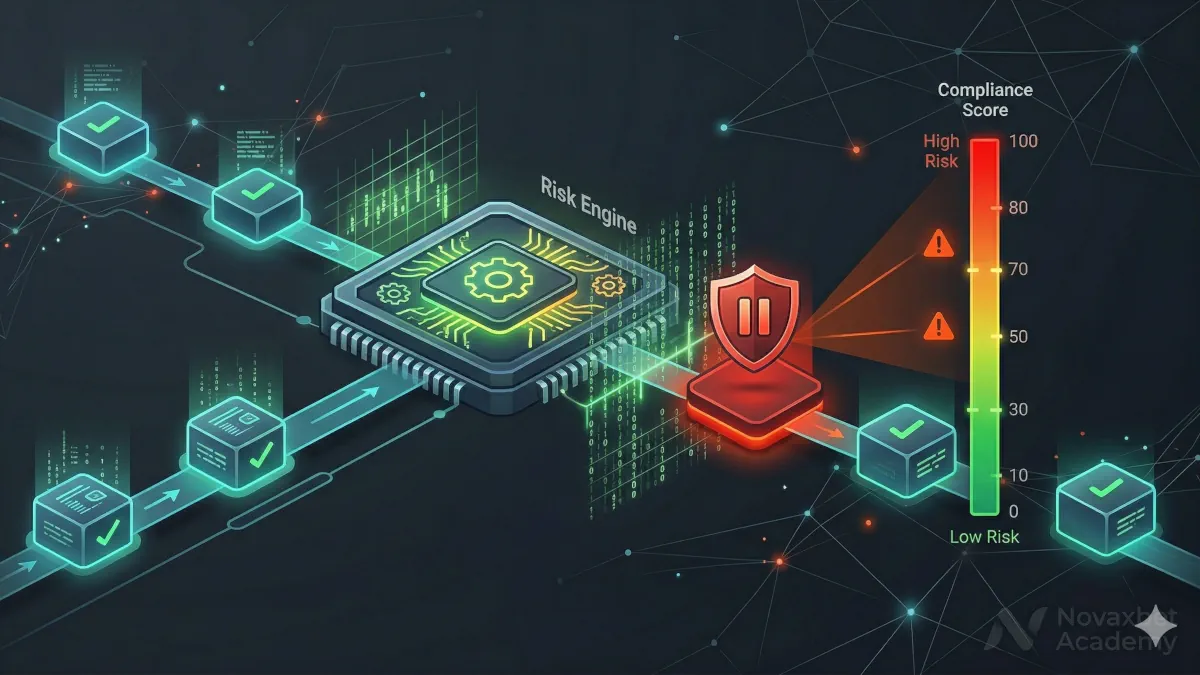
AML Triggers in Bank Payments
Explanation of AML triggers and how they affect bank payment processing.
Novaxbet Editorial •2026-05-11•3 min read
Instant bank transfers are designed with multiple layers of security to protect users, financial institutions, and payment platforms. Despite their speed, these systems rely on advanced safeguards to prevent fraud, data breaches, and unauthorized transactions.
Understanding how security works helps users trust and safely use instant payment methods.
Are Instant Bank Transfers Safe
Next reading
Instant bank transfers are generally considered highly secure.
This is because:
- banks enforce strict security protocols
- transactions are verified in real time
- multiple systems monitor for fraud
Security is built into every step of the process.
Bank-Level Security Measures
Banks provide the first layer of protection.
Key measures include:
- strong customer authentication (SCA)
- encrypted communication channels
- fraud detection systems
These protections ensure that only authorized users can initiate payments.
Strong Customer Authentication (SCA)
SCA requires users to verify their identity using multiple factors.
Typical methods include:
- something you know (password or PIN)
- something you have (mobile device)
- something you are (biometric data)
This reduces the risk of unauthorized access.
Encryption and Data Protection
All sensitive data is protected using encryption.
This includes:
- login credentials
- transaction details
- personal information
Encryption ensures that data cannot be intercepted or read by unauthorized parties.
Real-Time Fraud Monitoring
Payment systems continuously monitor transactions.
They analyze:
- transaction patterns
- user behavior
- location and device data
Suspicious activity can trigger alerts or block transactions instantly.
Role of Payment Providers
Payment platforms add an additional security layer.
They:
- integrate with secure banking APIs
- apply internal risk checks
- monitor transaction flows
This enhances protection beyond the bank level.
Secure API Connections
APIs connect banks and platforms securely.
They ensure:
- authenticated data exchange
- encrypted communication
- controlled access to information
APIs are critical for maintaining system integrity.
User Authorization Control
Users must explicitly approve transactions.
This typically involves:
- confirming the payment in a banking app
- using biometric or PIN verification
No payment can proceed without user consent.
Protection Against Fraud
Multiple systems work together to prevent fraud.
Common protections include:
- transaction limits
- behavioral analysis
- blacklists and risk scoring
These mechanisms reduce fraud risk significantly.
What Happens If Fraud Is Detected
If suspicious activity is identified:
- the transaction may be blocked
- additional verification may be required
- the user may be notified
Early detection helps prevent financial loss.
Instant Payments and Irreversibility
Instant payments are often irreversible.
This means:
- transactions cannot easily be undone
- errors must be prevented before confirmation
Security focuses heavily on prevention rather than recovery.
User Responsibility in Security
Users play a role in maintaining security.
Best practices include:
- protecting login credentials
- using secure devices
- avoiding public networks for transactions
User behavior directly affects security.
Common Security Risks
While systems are secure, risks still exist.
Examples include:
- phishing attacks
- social engineering
- compromised devices
Awareness reduces exposure to these risks.
How to Stay Safe When Using Instant Transfers
Users can improve safety by:
- verifying payment details carefully
- only using trusted platforms
- enabling security features like biometrics
- monitoring account activity
Simple habits significantly improve protection.
Trust in Modern Payment Systems
Instead of assuming:
“Instant payments are risky because they are fast”
A more accurate understanding is:
“Speed and security are designed to work together”
Modern systems balance convenience with strong protection.